Last updated
Overview
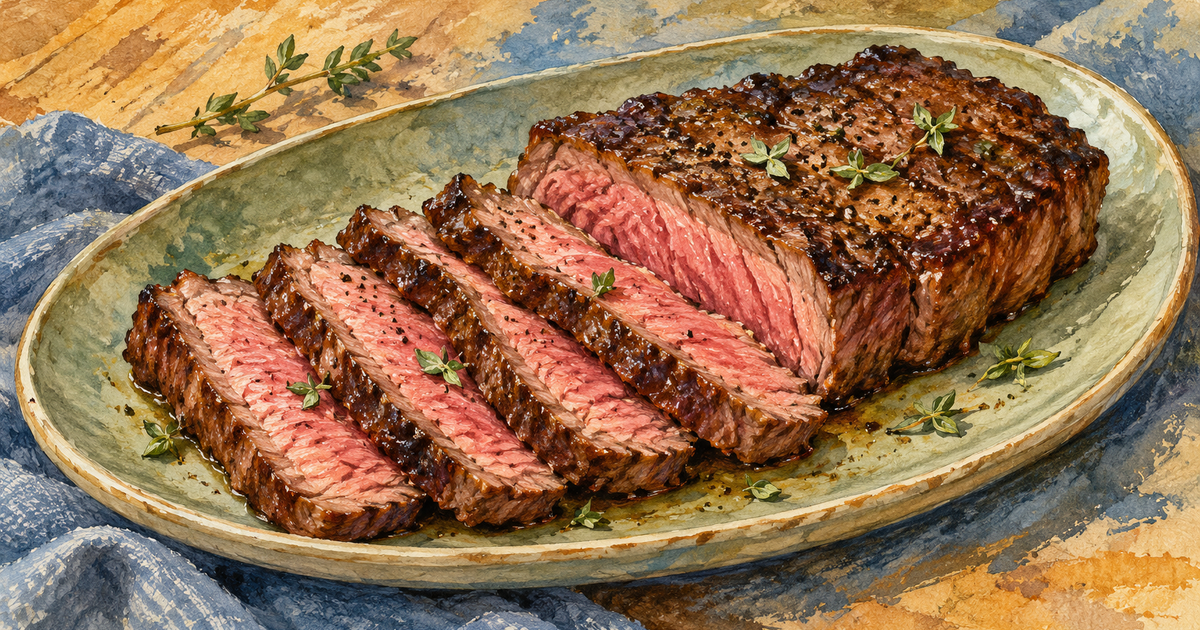
Denver steak has generous marbling and a pronounced grain. A steady bath gives it time to soften without taking the center past medium-rare, while a short pan finish adds the browned crust. Slice across the grain to shorten the muscle fibers.
This guide uses a complete timed cook for individual flat steaks; a whole chuck roast, rolled meat, and pieces with injected seasoning need different instructions.
Time and temperature
Swipe to see all columns
| Texture | Bath setting | Cook time |
|---|---|---|
| Medium-RareApplies to: Plain boneless intact Denver steaks with flat faces, no more than 1 1/8 inches thick, starting at 41°F. | 131°F | 3 hours |
Before you cook
- Food and size
- Use plain boneless Denver steaks with two broad flat faces, no more than 1 1/8 inches thick at the thickest point.
- Preparation
- Use fully thawed, intact meat without injected solution, mechanical tenderizing, brining, or marinade. Season with salt and pepper only; add butter, herbs, and sauces after cooking.
- Verify a 41°F starting temperature and a 131°F bath with a thermometer. Seal each steak separately, keeping it flat without folding, rolling, or overlap. Fully submerge in the preheated circulating bath with water space around each bag.
- Timing
- Start timing at immersion and cook for the full 3 hours without interruption. This time includes heating; do not add a separate heating period.
- Check and serve
- Use clean utensils, discard bag liquid, dry, brown briefly, slice, and serve immediately.
- Limits
- These instructions do not cover frozen or unknown starts, thicker steaks, whole roasts, ground or stuffed meat, chilling, storage, reheating, or holding.
Texture and result
- 131°FMedium-Rare
- A rosy, sliceable center with softened marbling and a briefly browned exterior.
Best for
- Plain boneless whole Denver steaks with flat faces, no more than 1 1/8 inches thick, starting at 41°F.
Get it ready
- Choose plain boneless Denver steaks. Measure the thickest part after trimming; keep each steak no more than 1 1/8 inches thick and flat without pounding, folding, or tying.
- Check that the fully thawed steaks start at 41°F. Season with salt and pepper only and seal each steak in its own food-safe cooking bag.
- Verify the preheated circulating bath at 131°F, fully submerge the bags with water space around them, and start the full 3-hour time at immersion.
Finish and serve
- Complete the full uninterrupted bath time before opening the bags. Discard the bag liquid.
- Lift the steaks with clean utensils and pat every surface dry. If the timed cook's conditions were not met, follow the hotter thermometer check and rest in Cook safely instead.
- Heat a heavy skillet with a little high-smoke-point oil. Brown both broad faces and the edges briefly, turning as soon as a crust forms rather than continuing to heat the center.
- Add fresh herbs or butter after browning if wanted. Slice across the grain and serve immediately.
Useful tips
- Note the grain direction before cooking so it is easy to cut across it after searing.
- Dry the sides as well as the broad faces; a wet edge steams in the skillet.
- Use the chuck-roast guide for a whole roast rather than extending this steak's time by guesswork.
Common problems
- The slices are chewy
- The steak was cut along the grain or a different chuck cut was used. Confirm the cut with the butcher and slice thinly across the visible grain.
- The outside stays pale
- Moisture on the surface cooled the pan and produced steam. Dry thoroughly and sear in an uncrowded hot skillet with a little oil.
Questions
QIs Denver steak the same as chuck roast?
QDoes the 3-hour time include heating?
QCan I add a marinade to the bag?
QCan I cook a frozen or thicker steak this way?
Cook safely
Keep raw beef separate from ready-to-eat food and use clean utensils after cooking. This timed cook requires every stated preparation, thickness, starting-temperature, and bath condition. Complete the full 3 hours from immersion.
If any condition cannot be met, cook with additional heat until the thickest center of every steak measures at least 145°F, recheck cooler spots, and rest at least 3 minutes after the final heat before slicing.
That hotter alternative gives a firmer result. Color and a browned crust do not replace either complete cooking instructions or thermometer measurements. Serve immediately; this guide does not cover chilling, sealed storage, reheating, or hot holding.
Sources and further reading
- Sous-Vide Denver Steak — Naftali Hanau, Grow & Behold
Describes the cut and pan finish; this guide uses the separately sourced timed cook below.
- A Practical Guide to Sous Vide Cooking — Douglas Baldwin, Table 5.1
Supplies the bath setting, complete cooking time, starting temperature, and thickness limit.
- Safe Minimum Internal Temperatures — FoodSafety.gov
Supports the hotter thermometer check and rest described in Cook safely.