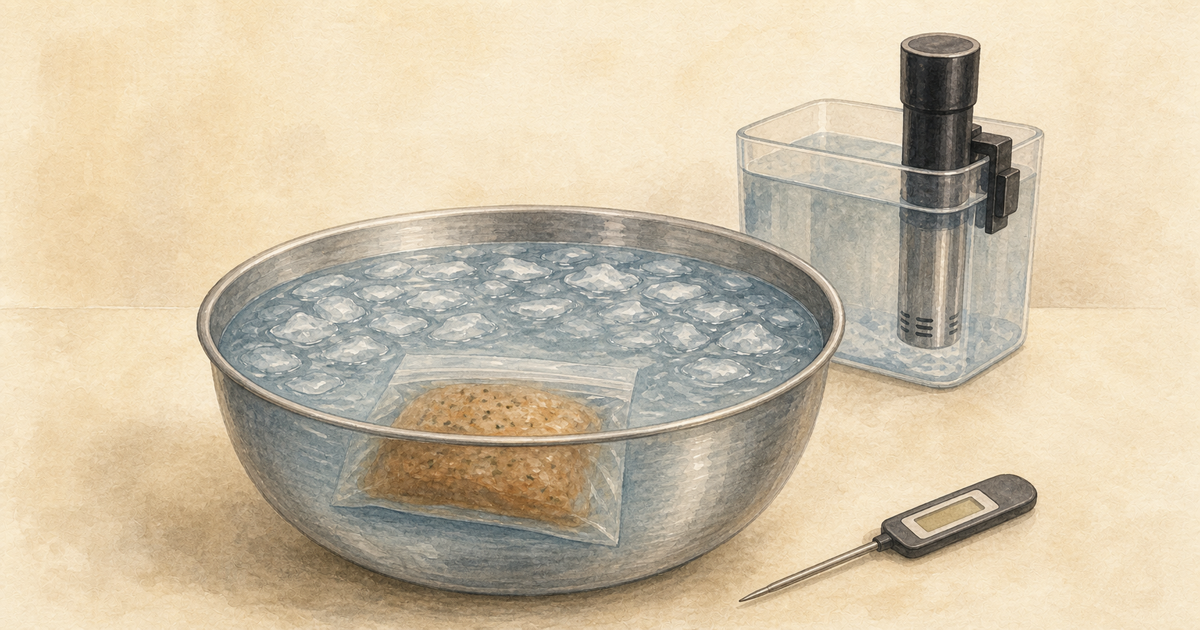
Understanding sous vide safety
Sous vide cooking is safe when time and temperature are managed together. Higher temperatures kill bacteria faster; lower temperatures need longer holds to reach a similar safety margin.
Guide times on LearnSousVide are starting points for the specific food and texture. Use the full guide notes for thick pieces, poultry, seafood, and long cooks.
When your food does not match a guide
These are conservative government thermometer temperatures, not a general set of sous vide times. Use a lower temperature only when the food guide also gives the full cook time, maximum thickness, starting temperature, bagging directions, and serving instructions. If your food does not match the guide, use the temperature in the chart above.
| Food type | Internal temperature | Notes |
|---|---|---|
| Beef, pork, lamb whole cuts | 145°F | Rest 3 minutes |
| Ground meat and sausage | 160°F | Verify the center |
| Poultry | 165°F | Whole, parts, ground, and stuffing |
| Fish | 145°F | Or opaque and separates easily |
| Egg dishes | 160°F | Cook shell eggs until firm |
| Leftovers and casseroles | 165°F | Reheat evenly |
Lower temperatures and storage
A water temperature by itself is not a complete cooking method. Follow the food guide's full cook time, timer start, maximum thickness, and starting-temperature directions. If your food falls outside those limits, use the government thermometer temperature instead.
Unless a guide gives specific cooling, storage, and reheating directions, serve the food right after cooking. A guide written for dinner now does not tell you how long leftovers will keep or how to reheat them.
Keep the kitchen clean
- Start with fresh, properly refrigerated ingredients.
- Keep hands, boards, knives, bags, and plates clean to avoid cross-contamination.
- Use food-grade bags and keep them sealed through the bath.
- Do not overcrowd the container; water needs to circulate around every bag.
- Sear with high heat after the bath and use clean utensils for finished food.
- Serve right away unless the food guide gives specific chilling, storage, and reheating directions.
Cooking for higher-risk diners
For pregnant people, young children, older adults, and immunocompromised diners, use the conservative USDA temperatures above unless a food-safety professional has given you another method.
This content is educational. When in doubt, cook to higher temperatures and follow USDA or local food-safety guidance.