Last updated
Maintained by John Hentrich at LearnSousVide
How we review our contentOverview
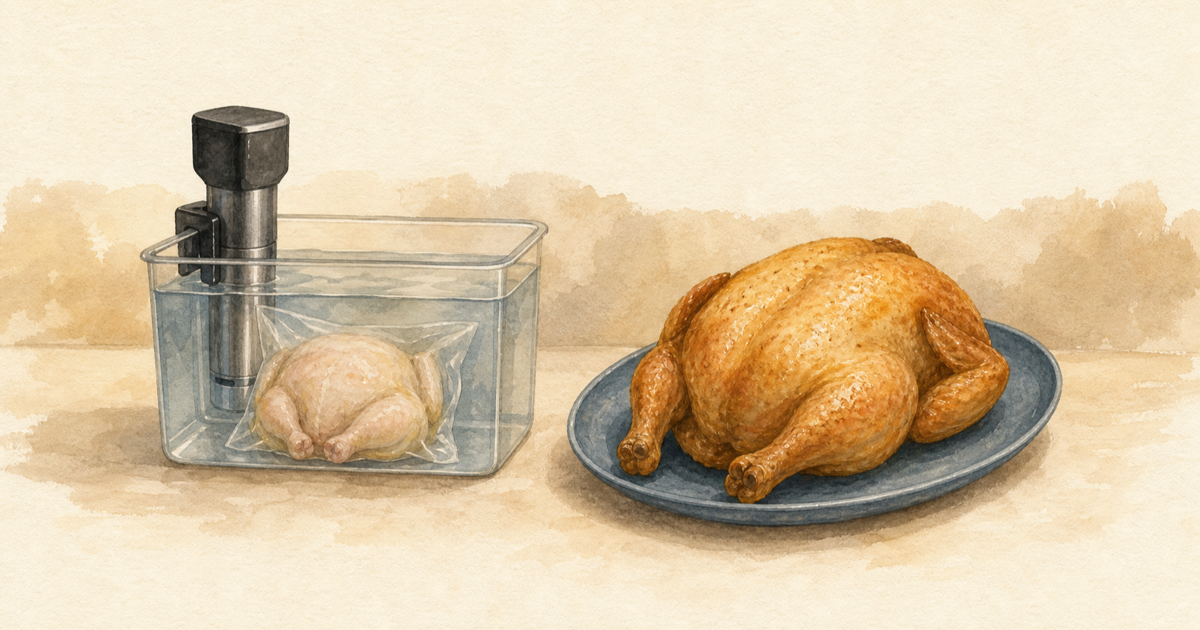
Keep the cavity empty and seal the unbound chicken in a large bag. After cooking, dry the skin well and use a hot oven, broiler, or grill to brown it.
Time and temperature
Swipe to see all columns
| Texture | Bath setting | Cook time |
|---|---|---|
| Standard | 150°–155°F | 3 hours 30 minutes–4 hours |
| Traditional | 155°–160°F | 3 hours–3 hours 30 minutes |
| Well-Done | 160°–165°F | 2 hours 30 minutes–3 hours |
Choose the time that matches the texture you want. Start timing when the bag goes into the fully heated water bath, and read the Cook safely section before serving.
Choose your texture
- 150°–155°FStandard
- Juicy breast meat and tender dark meat in the same bird.
Best for
- Whole roasting chickens (3–5 lbs)
- Family dinners
Notes
- This is the preferred temperature for whole chicken
- Finishing under the broiler brings everything together
- The innermost thigh, innermost wing, and thickest breast must all pass before serving right away.
Tips
- Dry brining for 2–8 hours helps produce crispy skin when finished
- Use an extra-large bag or 2-gallon zip-top bag for whole chickens
- Keep the bird whole, untrussed, and unstuffed for this guide. Use a bag large enough to hold its natural shape.
- Save the bag juices for making gravy
- 155°–160°FTraditional
- A firmer bite closer to classic roast chicken.
Best for
- Conservative diners
- Traditional preferences
Notes
- Closer to traditional roast chicken texture
- Dark meat benefits from the higher temperature
- The innermost thigh, innermost wing, and thickest breast must all pass before serving right away.
Tips
- This temperature satisfies those who prefer traditional texture
- Still much juicier than conventional oven-roasted chicken
- Finish with high heat for crispy skin
- 160°–165°FWell-Done
- Firm, fully cooked meat throughout the bird.
Best for
- Maximum safety margin
- Traditional expectations
Notes
- A 165°F bath setting does not replace measuring all three locations in the bird.
- Dark meat remains tender even at this temperature
- The innermost thigh, innermost wing, and thickest breast must all pass before serving right away.
Tips
- Best for shredding or slicing for other uses
- Make rich gravy to complement the firmer breast meat
Get it ready
- Remove the giblets and keep the cavity empty.
- Season the exterior and place aromatics beside the bird.
- Seal the unbound whole chicken in a large food-safe bag.
Finish and serve
- Remove the whole-bird bag from the bath and open it with clean utensils. Transfer the whole bird to a clean surface away from raw-poultry juices.
- Check the innermost thigh, innermost wing, and thickest breast at 165°F. Use a food thermometer while avoiding bone; all three locations must pass.
- Do not judge safety by appearance or texture. Bath setting, elapsed time, appearance, texture, browning, sauce, crispness, and finishing do not show that the food is safe and never replace the thermometer check.
- Continue cooking and recheck any spot checked below 165°F. Do not manipulate, brown, carve, sauce, or serve the bird until all three locations pass before any finishing step.
- Pat the whole bird completely dry.
- Heat the oven to 450°F, or set the broiler to high, before browning the whole bird.
- Brush with butter or oil for browning.
- Place on wire rack over baking sheet.
- Roast 15–20 minutes until skin is golden and crispy.
- Rest for 10 minutes before carving.
- Carve on a clean board.
- Serve right away after every thermometer reading reaches the stated temperature.
Useful tips
- Keep the cavity empty and leave the bird untrussed. Choose a bag and bath large enough to hold it without compressing or folding it.
- Check the innermost thigh, innermost wing, and thickest breast before browning. One hot reading cannot stand in for the other locations.
- Pat the skin dry and follow the oven or broiler finish below. Use a rack to expose the skin to heat.
- Use a clean board and utensils for carving after the rest.
Cook safely
Use the bath time for texture, then use a food thermometer before serving. Check the innermost thigh, innermost wing, and thickest part of the breast. Every spot should reach 165°F. If any spot is cooler, keep cooking and check it again. Use clean plates and utensils, and keep cooked poultry away from raw juices.